Category: Uncategorized

archive.php

  • To Begin Again is Hope (Body Awareness Practice)

    To Begin Again is Hope (Body Awareness Practice)

    Dear Ones,

    The healing journey is not linear. It has hills, valleys, and when you reach a mountain top, there is a sense of elation and self discovery. Admittedly, when you dip into a valley it does not feel great, triggering the tender younger parts of you to arise with their well meaning, but constricted thinking.

    These younger versions of yourself were created at one time or another to help you survive, their managing roles are to keep you small and therefore safe. You can tell that they are younger as they have black and white thinking, “I have to be perfect, or I am worthless”, “I have to try really hard, or I’m lazy”, etcetera. Bring gentle awareness to their patterns, where they are in the body (usually a place of tension or even pain). Befriend the area of pain/constriction instead of pushing it away. Practice curiosity and ask the question: “what do you need me to know?”.

    The negative messages that you received in childhood can be shed now, as they are not the truth. The simple question is: “How could a small baby or child be not worthy and deserving of love?” You are your greatest healer, and why not free yourself to begin again and BE YOUR MORE….

    I have attached below, some Body Awareness Practices that I share with my clients.  Practice one thing for 30-60 seconds twice a day.  Slow is better as the body and the parts that live within it do not like change in the system, and new neural pathways built, need tender care and patience to build.

    Body Awareness Practices to Support Regulation

    Breathing Techniques: Begin by exhaling fully, lowering your shoulders, breathing slowly and deeply, allowing your belly to rise and fall completely. Practice the 4 x 4 breath technique, also known as “box breath,” to maintain balance in your system. Inhale for 4 counts, pause for 4 counts, exhale for 4 counts, and pause for 4 counts before the next inhale. Try the 4-7-8 breath technique to suit your needs. A longer exhale helps shift your system into a more relaxed state (rest and digest- parasympathetic). 

    Exhalation Methods: Exhale with your mouth slightly open, lips almost touching as if blowing out a candle. Exhale through your nostrils while contracting the back of your throat, like saying “ha” with closed lips. This technique is known as ujjayi breath in yoga. 

    Working with Shortness of Breath: When your breath feels restricted, your body may signal danger due to its survival instincts. Approach your breath with curiosity, identifying if it is shallow (only filling the upper chest) or if you’re holding your breath. If your breath feels stuck, exhale completely before inhaling.

    Orienting Technique: Take a moment to slowly scan the room you’re in, consciously observing the light, colors, preferences, and sensations in your body with gentle self-compassion. Allowing the information from the eyes to inform your body to know, where your body is in the space it occupies, and where your body is in the room.

    Adrenal Support Work: The adrenal glands sit atop the kidneys and play a vital role in flushing stress hormones out of our bodies, particularly after prolonged periods of stress. These glands are part of our fight-or-flight response system. If the adrenals are not functioning optimally, leftover stress hormones can accumulate and become harmful, resulting in various physical symptoms and health issues. Working on the adrenals helps the body recall its parasympathetic response, ultimately training it to prioritize settling over tension. Support can be provided with laying down or leaning against a heating pad or hot water bottle. This action encourages the kidneys to release and lower the adrenal glands, promoting better nervous system regulation. This practice fosters an understanding and building trust between you and your body.

    Supporting Vagal Tone –  The vagus nerve is the cranial nerve X (CNX) or your tenth cranial nerve. It is also known as the “wandering nerve” because it is the longest parasympathetic nerve in the body. It has been compared to the conductor of the orchestra because it takes the lead in almost every autonomic function in the body. Science has confirmed that the vagus nerve is the key to wellness as it stimulates the “rest and digest” side of our nervous system, as opposed to the sympathetic “fight or flight” side of the nervous system.

    Seated: bring right ear towards right shoulder, head in line with body. without changing head position, look down as far as the eyes will go, to right shoulder. without changing head position, look up to the left as far as the eyes are comfortable. Pause and notice any changes. Repeat on other side.

    This is a lot of information, notice any tendencies to want to try harder or do more.  Invite in the practice of less is more, being gentle with yourself, and embracing the wisdom of the body.

    Yours in healing,

    Caroldean Jude,

    Somatic Trauma Therapist

    Somatic Experiencing® Therapy

    Transforming Touch® Therapy

    Internal Family Systems® Therapy
  • The Benefits of a Regulated Nervous System

    The Benefits of a Regulated Nervous System

    Dear Ones, 

    We are all aware of the impact of developmental trauma on our physical, emotional, mental, and spiritual well-being, and how it can affect the quality of life. I strongly believe in the healing potential within each individual. Let’s explore the importance of a regulated nervous system and how it can significantly enhance life. 

    The human nervous system, with its intricate complexity, serves a crucial role in regulating various bodily functions. It acts as a communication network, transmitting signals between the brain and the body to control functions such as heartbeat, thoughts, and emotions. Maintaining a well-regulated nervous system is essential for optimal physical and mental health. Let’s delve into the remarkable benefits of a balanced nervous system and how it can elevate overall well-being and resilience.

    Stress Reduction: 

    • A well-regulated nervous system plays a crucial role in helping our bodies effectively manage stressors in life. It enables a smooth transition between heightened alertness (fight or flight) and a calm, relaxed state (rest and digest), aiding in coping with life’s stressors and reducing the impact of chronic stress. 

    Physical Well-Being

    • Cardiovascular:  Nervous system regulation enhances the ability to cope with stress, leading to lower blood pressure and reduced risks of stroke and vascular dementia. 
    • Digestion: A balanced nervous system supports digestion by ensuring proper blood flow and energy utilization, benefiting food sensitivities, regular elimination, hunger cues, and food enjoyment. 
    • Immune System: Nervous system regulation boosts the body’s immune response and healing efficiency. 

    Better Relationships: 

    • A regulated nervous system enhances our ability to connect deeply with others, fostering empathy and emotional attunement for improved communication and harmonious relationships. 

    Enhanced Mental Clarity & Creativity: 

    • A balanced nervous system aids mental clarity and focus, enabling better concentration, problem-solving, and decision-making. A balanced nervous system allows the body to utilize more energy in the creative process, whatever that entails. Mindfulness practices and time spent in nature can also help regulate the nervous system, enhancing mental acuity. 

    Better Sleep: 

    • A balanced nervous system promotes high-quality sleep by facilitating the transition from wakefulness to relaxation, essential for physical and mental health. 

    Self-Regulation: 

    • Self-regulation is a vital skill supported by a well-regulated nervous system, empowering individuals to manage emotional and physiological responses, enhancing self-awareness and self-mastery for daily life and personal goals. 

    Longevity and Overall Well-Being: 

    • A well-regulated nervous system is linked to longevity and overall well-being by reducing stress effects, promoting health, and contributing to a vibrant and fulfilling life. It unlocks a higher quality of life by improving stress management, emotional resilience, relationships, and physical and mental well-being. 

    In conclusion, a regulated nervous system goes beyond personal well-being, offering a path to a more fulfilling life. By reducing stress, enhancing resilience, improving relationships, and boosting health, a well-regulated nervous system paves the way for vitality, connection, and joy. Through practices like Transforming Touch®, mindfulness, yoga, and somatic therapies, individuals can embrace these benefits, leading to holistic well-being and resilience. 

    Sources:  “Nurturing Resilience:  Helping Clients Move Forward from Developmental Trauma, An Integrative Somatic Approach, Kathy Kain, PhD, and Stephen J. Terrell, PsyD.  “Waking the Tiger”, Peter A. Levine, PhD,,  Mia Bolte TTPS

  • Nervous System Regulation in Pregnancy and Post Natal

    Nervous System Regulation in Pregnancy and Post Natal

    Dear Ones,

    I have reflecting on this as I have just become a Grammy for the first time, and sharing my daughter’s pregnancy, delivery and early days at home with her new son.  I was heartened by the encouragement of skin to skin contact from the nurses, with a message of “bringing moms and babies back together”.   A much-needed change for the future of our society, a coming back to recognizing how necessary nurturing babies is, and the vital importance of motherhood (fatherhood).

    Human babies are very vulnerable and totally dependent on mom’s or dad’s constant tending to their cries, diaper changes, feeding, and love.  These early days and months of being in close contact with our caregivers sets the foundation for life, our experience of the world as being either safe or dangerous, and creating healthy attachment bonds.

    I know from my family history, my own mother’s unexpected pregnancy, at the age of 19, in the early 1960’s, and how that affected her nervous system.  There was shock, judgment, and rejection she experienced from her family, and the subsequent stress of needing to get married quickly to legitimize the pregnancy.   So right from my conception I was exposed to her shame, fear, uncertainty, and her lack of maturity as well.   As I look back on my life and my early struggles with anxiety, it is no wonder that I felt unsafe, as my mom did not have the nervous system capacity to regulate herself, let alone me.   As I have studied this work and experienced my own healing from it, I appreciate the preciousness of motherhood and the early days of being born on this beautiful planet.

    I will invite all the pregnant women, and new mothers, to ponder this for themselves and their precious little ones. To be a safe haven for your babe shapes their future, and how they interpret the world as being safe or dangerous.  This will affect their ability to thrive, to be confident that no matter how far they reach, you would be there to catch them. There are no boundaries to how much you hold, pick up and sleep with your little ones, as you are building their early life experiences.


    A profound and beautiful role, as there is such potential to make a difference in the life of a child, and therefore the future of the planet. Relish your role as a mother/caregiver, as it is the most precious one you will play.

    This has led me to expand my offerings to include pregnant women and babies in my practice.  To support mother’s to be and their new infants to find nervous system regulation, resilience and adaptability in the shared experience of being a family.  I love the work that I do, and I hope that you will share this new offering to anyone who might be interested and/or need the support.

    With warm appreciation,

    Caroldean Jude

    Somatic Trauma Therapist

    Somatic Experiencing Practitioner

    Transforming Touch Practitioner

    Internal Family Systems Therapist

  • Allowing is An Empowerment of Choice

    Allowing is An Empowerment of Choice

    Dear Ones,

    Allowing is the internal practice of accepting things as they are/were as a gift to ourselves.  To choose to end the struggle of self rejection, self shaming or numbing of self, to the past.  It takes energy to bury wounds in the basement of our soma labeled “trauma”, which ends up in costing our health and feelings of well being. Allowing is the practice of gentle acceptance of what has happened, how it has affected us, and beginning the process of healing. 

    In experiencing early attachment wounds, oftentimes the idea of having a choice is not even in the realm of possibility.  Not having the lived experience of emotional/physical choice, often creates the foundation of being in “survival self” in our nervous systems.  In trying to seek safety as a small humans, we create behaviors, altering our essence and hiding our souls. This results in the foundation of early experiences of the world as one of less threat or more threat, and no sense of safety.


    As we get older the suppression of true self, living in survival self leaves us distrusting of ourselves/others and feeling disconnected.  There is that subtle allure of “if I adapt to my surroundings, I will not be rejected, I will be safe”, but what if we gave ourselves the freedom of not needing to suppress, alter or change who we are.  These early nervous system adaptations and behaviors, get in the way of living to our true potential and finding our joy and authenticity.


    I invite you to allow for the possibility of choice, and not grasp onto the surrender energy of “I have always been this way, I can’t change”. Allowing the gentle acceptance of past experiences, to free up your right to choose to be more. To begin healing, by shedding the survival self, and choosing life not tainted by past trauma. Reach for it, it has been there lovingly waiting for you. 

    With warm appreciation,

    Caroldean Jude

    Somatic Trauma Therapist

    Somatic Experiencing Practitioner

    Transforming Touch Practitioner

    Internal Family Systems Therapist

  • Resting is Important Self Care

    Resting is Important Self Care

    Dear Ones,

    In my past life, I would have either poo-pooed resting or told myself I was resting, but relentlessly planning and/or trying to figure out what things about my life I needed to fix. This pattern is a mix of social conditioning and my upbringing. “No rest for the “wicked”, “Buck up and soldier on”, “Bite the bullet.” Just to name a few and I know you have all heard one or all of these.

    I have asked myself the question “why is being busy, a way of living that we are encouraged to practice ?“ and “where did this start?”  Why indeed are we all caught up in looking busy, being busy and if you are not busy you are judged as being not driven enough, aimless and probably lazy.  I belief that we were not put on this planet to achieve more, life has to have balance and that means achieving is not more important than resting.  To be “more” in life requires both.

    Resting is necessary for emotional and physical health – period. The body needs downtime to rejuvenate energy stores, make the necessary repairs and to bolster the immune system. We Humans are not machines and need to acknowledge the essentialness of self care to a well rounded healthy life.

    I invite you to nurture yourself with the gift of rest. Not planning, not scrolling on the phone, just practicing holding space for all of you with gentle compassion. You are worth it. And yes, I now regularly practice the “Art of Rest” and savor it.

    Resting Practices:

    Walking in nature.  Meditation. Yoga.  Letting your senses drink in your surroundings.  Breathe slowly.  Read.  Allow thoughts to float away.  Do nothing and love it (what a concept!).  Check in on your internal organs and send them love.  

    Cultivating compassion for you while you are resting. 

    Happy Resting!

    With warm appreciation,

    Caroldean Jude,

    Somatic Trauma Therapist

    Somatic Experiencing Practitioner

    Transforming Touch Practitioner

    Internal Family Systems Therapist

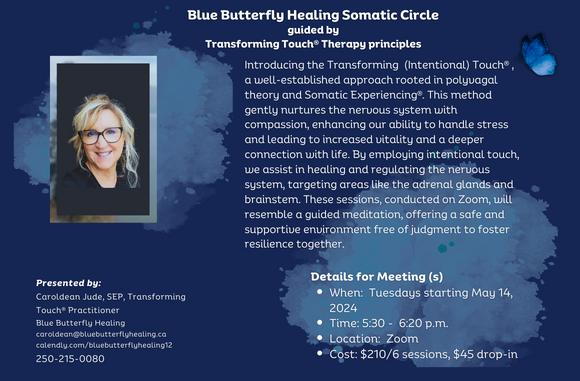
  • Blue Butterfly Healing Somatic Circle

    Blue Butterfly Healing Somatic Circle

    Dear ones,

    I have just completed my certification in Transforming the Experienced-Based Brain® (TEB) modality to become a Transforming Touch® Practitioner, and I am excited to share this gentle healing experience on a bigger scale.

    What is Transforming the Experienced-Based Brain?

    TEB is a Regulation Based Modality.  The modality is based on the theory that when we experience ruptures during our development years, the continue to disrupt our lives at any age.  This disruption can be seen as behavioral challenges, psychological challenges, spiritual challenges, and physical challenges.   As a Transforming Touch® Practitioner it is my passion to create a safe place for you to experience healing through a lens of safety, presence, and regulation.  I know that your body already knows how to heal itself if it is allowed more safety and less survival energy.

    As a TT Practitioner, I see you as whole and complete from the moment you enter my Healing Space/Office.  I do not rely on pathology to label my clients.  I lean into the ideal that your body is capable of creating new neural pathways in your brain that allow for less stress/anxiety and more ability to learn, relate, and heal.

    I will be meeting with group members individually by telephone for a 30-minute discussion/goal setting prior to group start, that is included in the six-session fee of $210.  I will be available in between for individual sessions as well as a quick check in. 

    It is my hope in this offering, that I will be able to share the possibility of greater regulation, presence, and vitality for life for all group members. Healing is possible and you deserve to claim back your life from past experiences/trauma that may be keeping you stuck.

    Spaces are limited and I hope to see you there!  For more information please contact me at 250-215-0080 or caroldean@somatictherapykelowna.ca

    With warm appreciation,

    Caroldean Jude,

    Somatic Trauma Therapist

    Transforming Touch® Practitioner

    Somatic Experiencing® Practitioner

    Internal Family Systems Therapist

  • The Felt Sense

    Dear Ones,

    Happy April everyone!   My workshop “The Art of Healing” (combining Trauma-Informed yoga and Transforming Touch) was a success and I will be offering another series in the fall. 

    I have moved office spaces this week and will now be at 11-1638 Pandosy Street, in Kelowna.  This space is welcoming, warm, and decorated in my favorite muted blue colour(s).    I also will be able to  bring my little Yorkipoo (Lily) to my sessions, and I am sure her gentleness will bring extra healing to our time there.

    It is my goal to be offer in the late summer to early fall, group healing sessions over Zoom utilizing Transforming Touch modality to support nervous system regulation and healing.  They will be 50 minutes long, and there will be a drop-in option as well as purchase of several sessions at a discount available.  Please email me to let me know if you want to be included in either offering.

    The Felt Sense – What is it?  

    To experience and have awareness of the body from the inside. In general, society has valued thinking instead of being embodied and assumed that the brain was solely in charge of the body.  Scientifically speaking that is not always true with 80% of the information that we receive about our environment, whether we are safe and who is safe comes from the gut up to the brain.

    Qualities of Felt Sense

    • Feeling/Sensation
    • Pressure – even, uneven, supportive feeling, crushed feeling, cutting off circulation.
    • Air current – gentle, cool, warm, from right, from left, stimulating, rush, like a feather, like mist.
    • Tension – solid, dense, warm, cold, inflamed, protective, constricting, angry, sad.
    • Pain – ache, sharp, twinge, slight, stabbing.
    • Tingling – pricks, vibration, tickling, numb.
    • Itch – mild itch, angry itch, irritating itch, moving itch, subtle itch, small itch, large area of itching.
    •  Temperature – warm, hot, burning, cool, cold, clammy, chills, icy, frozen, like:  hearth, even, fire, sunshine, baked bread, snow, stone, shade.
    • Size – small, large, tiny.
    • Shape – flat, circle, blob, like a mountain.
    • Weight – density, light, heavy.
    • Motion – circular, erratic, straight line.
    • Speed – fast, slow, loping, still.
    • Texture – rough, wood, stone, sandpaper, smooth, silky.
    • Element – fire, air, earth, water, wood.
    • Colour – gray, blue, orange etcetera.
    • Mood/Emotion – sinking, pulling in, open, closed, uplifting, sunny day, dark cloud, roiling, volcano.
    • Sound – buzzing, singing, humming, ringing.
    • Taste – sour, bitter, sweet, tart.
    • Smell – pungent, sweet, like rain, like leaves, like summer.

    Think of the above as descriptors that may help you discern what your bodily experience is like.  The practice is in (small amounts) bringing awareness to sensations, feelings, and allow them to be witnessed/felt.  Creating curiosity/space for what has been previously pushed away, is the path towards healing and a deeper sense of compassion for you and all that you have been through.  Remind yourself often – that you are here, you are alive, and you survived.

    With deep appreciation,

    Caroldean Jude

    Somatic Trauma Therapist

    Transforming Touch Practitioner

    Somatic Experiencing Practitioner

    Internal Family Systems Practitioner

  • Come Back Home To You

    Come Back Home To You

    developmentaltraumatraumahealingnervoussystemregulationtransformingtouchtherapy#somaticexperiencingsomatictraumatherapyinternalfamilysystemstherapycptsdtherapydevelopmentaltraumatherapydevelopmentaltraumasupportchronicfatiguechronicpainanxietyhelpdepressionhelpptsdmentalhealthwomantherapistwomensupportingwomenselfagency

    Dear Ones,

    Of the many faces and roles that you were and play in your life – who is the real you? Different versions in life like the work you, you that is a friend, the mom and/or the partner you, all sometimes are needed, and who are you really? Your wants, needs, likes, and dislikes, favourite things and places, traumas, desires, greatest joys, values in life, are important parts of you and not all of you.

    When I was going through my divorce, my therapist at the time asked me; “what do you want?”, what are your needs, “who are you at your core?”, and I had no answers. I had been living life from a place where I came last, after the children, after the husband, and what I wanted or needed was not in realm of important.  It took some time to shed the layers and roles that I expected of myself as a mother and a wife, to uncover the person underneath. Then there came the awareness of the trauma of my childhood, that I had deeply stored away in the tissues of my body, waiting for me to have the courage to heal.  Needless to say, it has been an amazing journey of self, a coming home, acceptance, and gratitude for it all, because it has led me to my life’s work as a somatic trauma therapist.

    Developmental trauma has many versions that are all painful, and as small people to survive.  you alter and suppress your essence, your joy, your wants, needs, your very authenticity.  These survival versions of you oftentimes are carried on through into adulthood and are assumed to be you, without question.  Some of these versions (that are not you) are burdens that have been taken up by you and are not yours to carry. 

    Some of the physical/mental health costs are anxiety disorders, OCD, depression, digestion disorders, chronic fatigue, chronic physical pain, addictions, and sometimes autoimmune disorders.  All of the above can be manifestations and the cost of an overburdened nervous system,

    I invite you to gently turn towards the parts of you that you have rejected, put on fresh loving lenses, and practice curiosity and compassion for your wounded bits.  When you can start to make space for younger versions of you, there is often a shift, an evolving understanding, deepening self-awareness, culminating to a place to where healing can grow.

    Gift yourself the love, acceptance you did not receive as a child, and start to nurture and cultivate your resilience.  Come back home to you and live life authentically from a place of self-agency, as the world needs your authenticity, your open heart, and your resilience.  It is time to be more.

    With warm appreciation,

    Caroldean Jude,

    Somatic Experiencing Practitioner

    Somatic Trauma Therapist

    Internal Family Systems Therapist